
Remodeling guide
Stair Runner vs Carpet for Homeowners: Ask About Safe Fit and Wear

Choose a stair runner if you want to show off your wood treads and add a tailored accent. Choose full carpet if you want the most cushioning and the quietest steps. Either way, safety depends more on secure installation and sturdy handrails than on the material itself, and upkeep and replacement costs differ. A practical checklist and installer questions follow.
TL;DR:
- Among older adults, 26% of trips over obstacles involved carpets or rugs; secure every tread, keep transitions flush, and install handrails on both sides.
- Installers should use a firm, dense pad and round stair noses by 3/4 to 1 inch after checking treads and risers for damage.
- A runner concentrates wear in one strip and can be replaced alone, while full carpet covers wood edges and usually requires whole surface replacement.
- For busy stairs, nylon and tight loop or berber construction resist wear; wool costs more, while olefin can crush faster under heavy traffic.
- Ask whether installers will stretch carpet over tack strips or glue it down; stretch installation is easier to lift later, while glue can leave residue.
Table of Contents
- How do a runner and full carpet change the look of your stairs?
- Which option feels softer and quieter underfoot?
- How do you keep stairs safe with a runner or full carpet?
- How do cleaning and wear compare over time?
- What affects the cost and installation of each option?
- Which fibers and constructions hold up best on stairs?
- What is the best way to choose between a runner and full carpet?
- What do we see on real stair projects?
- How can we help with your stair project?
- FAQ
- Sources
How do a runner and full carpet change the look of your stairs?
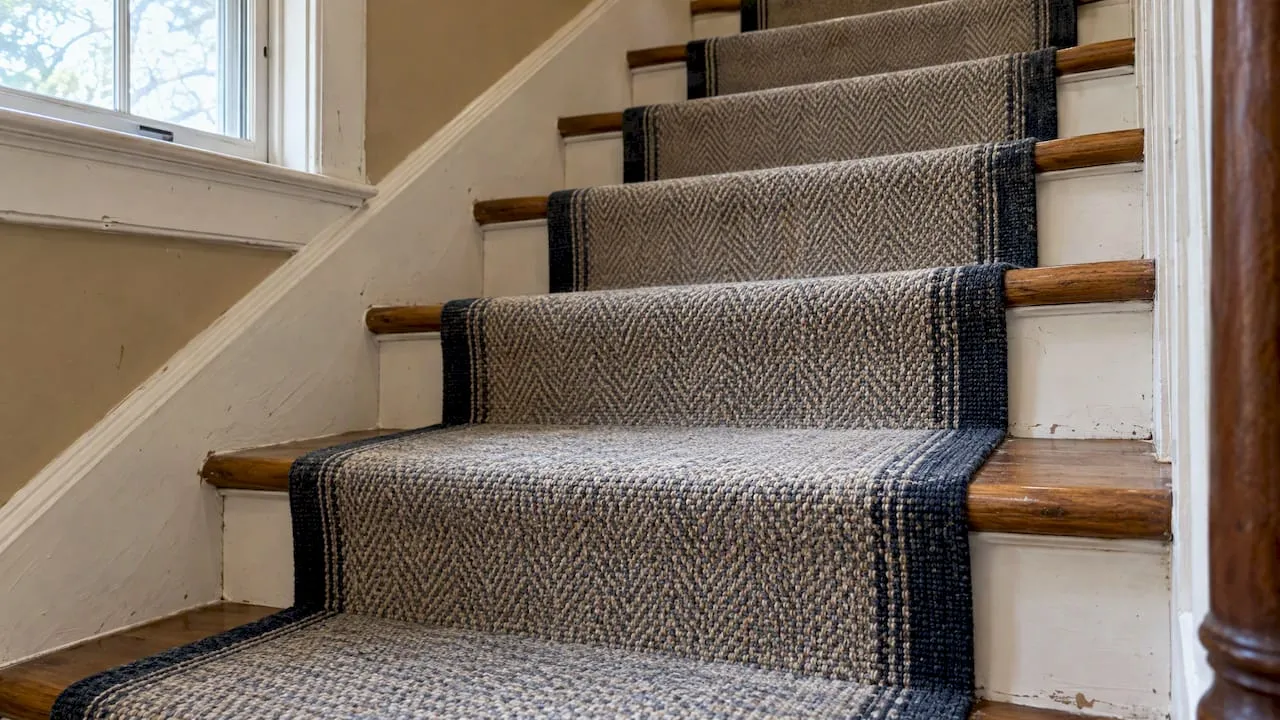
A runner leaves the sides of each tread exposed, so wood grain, stain color and the shape of the staircase stay visible. Full carpet covers everything and creates one continuous, streamlined surface that blends into the floors above and below.
Here are the main style options:
- Center runner: a strip down the middle with even wood margins on each side.
- Border runner: a runner with a contrasting edge band that frames the steps.
- Patterned runner: stripes, geometrics or florals that turn the stairs into a focal point.
- Cap-and-band: full carpet finished with a clean band over each tread and riser.
- Contoured: wall-to-wall carpet that follows curves and winders in one smooth piece.
Color and pattern also change how wide the stairs feel. A runner in a tone close to your walls can make the stairway look wider, while strong stripes draw the eye up the middle. As for trends, stair runner installations rose 402% in Yelp’s 2026 forecast cited by Realtor.com, so statement stairs are clearly in demand.
Which option feels softer and quieter underfoot?
Full carpet over a good cushion wins on softness and sound absorption, because every inch of the tread and riser is covered. A runner can sit on an underpad too, but it generally delivers less total cushioning, and the bare wood at the sides still reflects sound.
Two choices shape how stairs feel:
- Pile height and density: dense, lower pile feels firm and stable. Tall, plush pile feels soft but can feel squishy on a narrow tread.
- Pad type: firm, dense pads absorb noise without letting your foot sink. Soft, thick pads feel cozy but reduce stability.
Pro Tip: On stairs, pick a thinner, firm cushion rather than a thick, spongy one. You still get sound control, and your foot lands on a stable surface, which lowers the chance of a misstep.
How do you keep stairs safe with a runner or full carpet?
Material is only part of the story. The U.S. Consumer Product Safety Commission’s hospital-record analysis of older adults found that 26% of trips over obstacles involved carpets or rugs, and it lists stairs among the common elevation-change trip spots. Loose or badly fastened coverings are the real hazard.
Installation matters just as much. Industry standards from the Carpet and Rug Institute call for treads, risers and the stair nose to be clean and sound, and recommend rounding the stair nose by 3/4 to 1 inch. A professional rug installer notes the same prep keeps the backing from being cut and avoids fastener problems.
These controls matter most:
- Fasten every tread securely so nothing shifts or ripples.
- Install handrails on both sides, as CPSC guidance recommends, and keep stairs well lit.
- Use anti-slip backing or the right adhesive for your method.
- Keep transitions at the top and bottom flush.
- With small children, consider an adjustable child rail below the main handrail.
For kids, older adults or any tricky staircase, a professional installer is the safer call.
How do cleaning and wear compare over time?
Stairs wear fastest where feet land, usually the center of each tread and the nose. A runner localizes that wear to one strip, while full carpet spreads it across the whole surface.
- Runners: vacuum the strip and the exposed wood edges, and dust the margins so grit does not scratch the finish. Spot-clean stains on the runner without soaking the wood beside it.
- Full carpet: vacuum the full surface and spot-clean as needed. Because everything is covered, there are no wood edges to maintain.
- Repairs and replacement: a worn runner can often be swapped alone, and the wood beneath stays in place. Full carpet is usually replaced as a whole.
Your installation method also affects the future. Stretch-in carpet over tack strips can be lifted and replaced more easily than glue-down, which leaves adhesive residue to deal with. Ask your installer how each method will age before you commit.
What affects the cost and installation of each option?
Runners are commonly attached with rods or fasteners at each step. Full carpet is stretched in over tack strips or glued down, and wrapping every tread and riser takes more time. Both need prep: rounding the nose and securing loose treads adds labor but protects the carpet.
The main cost drivers are:
- Material quality and fiber type
- Pad thickness and density
- Stair shape, such as curves, winders or open sides
- Removal of old flooring
- Local labor rates
Before you hire anyone, ask these questions:
- Will you round the stair noses, and how?
- What pad do you recommend for stairs?
- How will edges and transitions be finished?
- Is my method stretch-in or glue-down, and why?
- What warranty and expected lifespan do you offer?
Professional installation is the better choice for curved, open or steep staircases.
Which fibers and constructions hold up best on stairs?
Stairs are the hardest-wearing spot in most homes, so fiber and weave matter.
- Wool: durable and naturally resilient, but it costs more and can stain.
- Nylon: tough and bounces back well, a reliable default for busy stairs.
- Triexta: soft and stain resistant, a good fit for households with kids.
- Olefin: budget friendly and moisture resistant, but it can crush faster under heavy traffic.
Tight constructions resist traffic best. Loop or berber styles hold up well, textured cut-pile hides footprints, and plush, loose cut-pile shows wear sooner. For padding, choose a firm, dense pad that cuts noise without adding height, since a soft stack of cushion creates a trip hazard.
If pets share your home, our post on pet-friendly flooring options covers durability choices worth considering.
What is the best way to choose between a runner and full carpet?
Work through these prompts in order:
- Style goal: do you want to feature the wood or create a seamless look?
- Household: consider kids, pets and older adults using the stairs daily.
- Noise: how much do footsteps bother the rest of the house?
- Budget: include the pad, prep and labor, not just the carpet.
- Wood: do you want to keep or refinish the treads?
The decision rules are simple. If you want to preserve and show your wood and add an accent, go with a runner. If you want maximum cushioning and quiet, go with full carpet. If you plan to refinish or showcase hardwood treads, a runner is the natural pairing.
At the quote stage, ask about pad thickness, edge finishing, whether the stair noses need rounding, and the warranty and expected lifespan.
Pro Tip: Bring a carpet sample home and lay it on a stair for a day. Check the color in morning and evening light, and see how it feels under a sock-covered foot.
What do we see on real stair projects?
Stairs hide surprises. Once the old covering comes off, we often find worn nosing, uneven risers or loose treads that were invisible before. Skipping that prep can contribute to problems, because a covering laid over a weak surface may shift or wear unevenly.
Our approach is built on planning, honest material guidance and clean execution, so you know what you are getting before work begins. When your stairs are curved, steep, open on one side or used by children and older adults, hiring a professional is the safer and longer-lasting option.
— Vlad
How can we help with your stair project?

We handle carpet installation, stair prep including rounding the nose, hardwood work, floor removal and trim, so your stairs are done right from the base up. Bring photos, stair dimensions and your priorities to an estimate, and we will walk through materials, method and scope with no pressure.
- Photos of your staircase from the bottom and the top
- Measurements, or a note on stair count and any curves
- Your top priorities: style, softness, noise or budget
See our full range of flooring services and request a consultation or estimate today.
FAQ
Can you make any carpet into a stair runner?
Many carpets can be cut and bound into a runner, but not all suit stairs. Choose a dense, durable construction and have the edges professionally finished so they do not fray.
Are runners on stairs in style?
Yes. Runners are popular as a statement feature, and Realtor.com reported homeowners embracing statement staircases in 2026.
What are the different types of stair runners available?
Common styles include center runners, border runners and patterned runners, in materials from wool to nylon and triexta. Your choice depends on how much wood you want to show and how much traffic the stairs see.
Is a runner or full carpet safer on stairs?
Neither is safer on its own. Secure fastening, handrails, good lighting and flush transitions matter far more than which style you choose.
Sources
- Senior Hazards Sketch 2021
- CRI Carpet Installation Standard 2011
- Rugartisan
- Forget Other Upgrades—This Statement Feature Is What Buyers Want in 2026
