
Remodeling guide
Under Cabinet Lighting Types: Bars, Strips and Pucks Compared
There are three main types of under cabinet lighting: LED light bars, LED strip (tape) lights and LED puck lights. For most kitchens, a bar or a strip in a diffusing channel gives the best countertop light, because it lays down a continuous, even band with no dark gaps. Pucks are better for accent light inside display cabinets or over a short stretch of counter. Below we compare the types, explain color temperature, and cover the wiring decisions that are easiest to get right during a remodel.
TL;DR
- Light bars, strips and pucks are the three formats most homeowners choose from, and all three now use LEDs.
- For food prep counters, choose a bar or a strip. Use pucks for accent lighting in glass-front cabinets and shelves.
- Pick 3000K for warm wood tones and 4000K for white or gray cabinets, or choose a tunable white system and decide once the counters and backsplash are in.
- On polished stone, put strips in an aluminum profile with a diffusion lens to avoid reflected dots of light.
- Plan the wiring, switch and driver location before drywall and cabinets go in. It is far cheaper than retrofitting.
Table of Contents
- What under cabinet lighting actually does
- The three main under cabinet lighting types
- Plug-in, hardwired or battery powered
- Color temperature: warm, neutral or tunable
- Light quality, brightness and lifespan
- Layout mistakes that spoil good lighting
- What we recommend in a remodel
- Planning lighting into a kitchen remodel
- Planning a kitchen or bathroom remodel in Redmond?
- FAQ
- Sources
What under cabinet lighting actually does
Upper cabinets cast a shadow over the exact place you chop, slice and read recipes. Ceiling fixtures sit behind you, so your own body blocks the light. Under cabinet fixtures put the light between you and the work surface.
LED is the right choice here for a physical reason as well as an energy one. The U.S. Department of Energy points out that LEDs are directional, so they can aim nearly all their light at the counter instead of losing a share inside a fixture, as older 360-degree sources do. The same DOE brief notes that residential under cabinet fixtures have typically used halogen or xenon sources, which render color well but are inefficient. LEDs have largely replaced them.
The three main under cabinet lighting types
LED light bars
A light bar is a slim, rigid fixture with the LEDs already built in. It is the most common form of under cabinet lighting and comes in plug-in, hardwired and battery-powered versions. Bars are simple to mount because the spacing of the LEDs is already engineered, which is why the light looks even right out of the box.
Best for: standard kitchen runs where you want a clean, continuous wash of light and a predictable result. Hardwired bars are the tidy option for a remodel, since the wiring disappears into the cabinet or wall.
LED strip lights (tape lights)
A strip is a flexible ribbon of small LEDs that you cut to length. On its own it is the most customizable option, and it fits odd runs, corners and shallow cabinet bottoms. Strip lights give continuous linear light, which is why they are generally preferred over pucks for food prep areas.
The catch is finish quality. A bare strip can show individual dots of light, especially on shiny counters. Lumens advises mounting tape lights in an aluminum profile with a diffusion lens on reflective surfaces like granite or polished stone, so the counter shows a smooth line instead of a row of reflected LEDs. The profile also gives you a cleaner install, with the strip hidden behind the cabinet face frame or a small light rail.
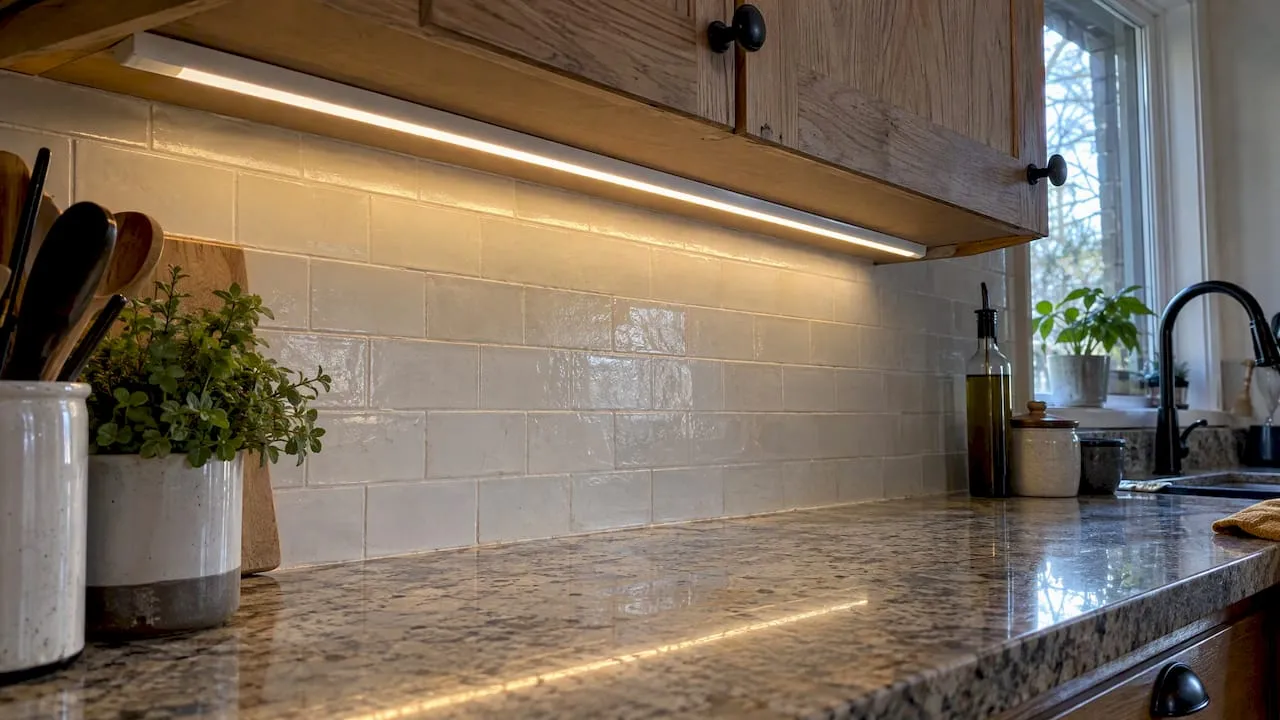
Best for: custom layouts, long uninterrupted runs and kitchens with polished or glossy counters, as long as you use a profile and diffuser.
LED puck lights
Pucks are small, round, individual fixtures, usually surface-mounted or recessed into the cabinet bottom. They are popular because they are easy to install and look good in a glass-front cabinet, where they spotlight dishes or collectibles.
The drawback is what lighting designers call scalloping: pools of light with darker gaps between them. Lumera Electric notes that pucks are usually spaced 8 to 12 inches apart to reduce those gaps, and still recommends strips for serious task lighting. If you love the look of pucks, space them tightly and keep them for accent zones such as a coffee station or a hutch.
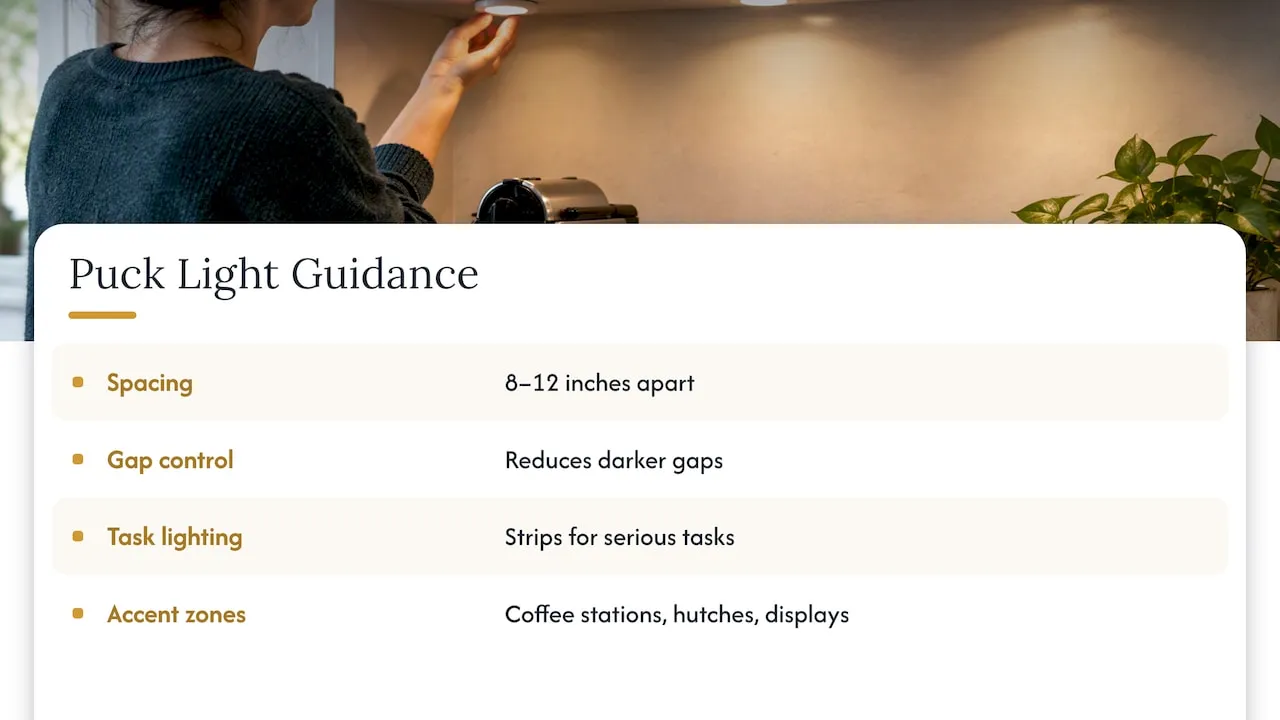
Best for: display cabinets, shelves, small nooks and spots where a pool of light is the point.
Side-by-side comparison
| Feature | Light bar | LED strip in profile | Puck lights |
|---|---|---|---|
| Light pattern | Continuous, even | Continuous, even | Pools with gaps |
| Best use | Countertop task light | Countertop task light, custom runs | Accent, display cabinets |
| Customizable length | Limited to bar sizes | Cut to fit | Add or remove fixtures |
| Install effort | Low | Moderate (profile, driver) | Low |
| Glossy counter risk | Low | Low with a diffuser | Visible hot spots |
If your question is strip versus puck, the answer for a working kitchen is strip. Monulo’s comparison reaches the same conclusion: strips for even task lighting, pucks for accents and specific areas.
Plug-in, hardwired or battery powered
The power method matters as much as the fixture shape.
- Plug-in: quick and removable, but you see the cord and the outlet is in use. Fine for a rental or a quick refresh, less ideal in a remodel where you want a finished look.
- Hardwired: wiring runs inside the wall and cabinet, controlled by a wall switch or dimmer. It is the cleanest result and the one we plan for in a remodel.
- Battery powered: easiest for a closet or pantry shelf, but not something you want for the main counter you use every day.
Most homeowners assume this is a plug-and-play job. In practice, low-voltage systems rely on drivers (transformers) that need ventilated space, such as inside a cabinet. Hiding them behind walls or in unventilated spots can shorten the life of the LEDs. Decide where the driver lives, and make sure you can reach it, before the cabinets are installed.
Color temperature: warm, neutral or tunable
Color temperature is measured in Kelvin (K). Lower numbers look warmer and more yellow, higher numbers look whiter and bluer.
- 3000K (warm white): widely favored to complement wood tones and warm ambient lighting. It suits oak, walnut and cherry cabinets and warm paint colors.
- 4000K (natural white): frequently recommended for modern kitchens with white or gray cabinets and lighter counters. Sensio’s guide says 4000K suits most worktops.
- Tunable white: the same Hafele guide describes systems that adjust from roughly 2700K to 6000K. This is a safety net if you are choosing lights before the counters and backsplash exist, because you can fine tune the light once you see it against the finished surfaces.
Whatever you pick, match the color temperature of the under cabinet lights to the other lights in the room as closely as you can. A 2700K ceiling and a 4000K counter strip next to each other will look mismatched, especially in an open plan. Our kitchen lighting plan guide covers how under cabinet light fits into the room’s overall layers, including light levels and code rules.
Light quality, brightness and lifespan
Three specs are worth checking on the box.
Lifespan. ENERGY STAR’s key criteria for LED fixtures include a minimum life expectancy of 25,000 hours and dimming down to at least 20%. Those criteria are written for downlights rather than under cabinet products, but they are a useful yardstick for quality. A fixture that holds 70% of its initial output for 25,000 hours will usually outlast a kitchen remodel.
Dimming. Dimming lets the same lights work as bright task lighting while you cook and as a soft night light afterward. Check that the driver and the dimmer are compatible, because mismatches cause flicker.
Color rendering. Food and countertop finishes look better under a high color rendering index. Halogen set the bar here, which is why DOE highlights that older sources rendered color well. Look for a good CRI rating on LED products rather than assuming all LEDs match.
Layout mistakes that spoil good lighting
- Scalloping from widely spaced pucks. Space them 8 to 12 inches apart or switch to a strip.
- Visible LED dots on stone. Use a profile with a diffusion lens.
- Light too far back. Mount fixtures toward the front of the cabinet bottom so the light reaches the counter’s front edge instead of washing only the backsplash. A small light rail also hides the fixture from people sitting at the counter.
- Mismatched color temperatures between runs. Buy all fixtures for a room from one product line and one batch where possible.
- Drivers buried where nobody can reach them. Put them in a ventilated, accessible cabinet space.
- Picking lights before choosing finishes. Counters and backsplash change how light looks. Tunable white fixes this, or you can test a sample strip once the surfaces are in.
What we recommend in a remodel
Under cabinet lighting is a finish detail that people notice every single day, yet it is often the last thing anyone plans. The best time to decide is while the walls are open.
Our perspective comes from planning kitchens in Redmond homes, where the sequence matters. We think about lighting alongside cabinet layout, because the cabinet bottoms determine where fixtures sit, and the countertop and backsplash selections determine the color temperature. When we lay out a project, we ask four questions:
- Where do you actually work? A short prep zone next to the range needs the most light.
- What are the counters and backsplash? Glossy surfaces call for diffused strips or bars.
- Do you want switches, dimmers or both? We locate wiring and switch boxes before drywall closes.
- Are there display cabinets? That is where pucks earn their keep.
For most homeowners, our default is a hardwired bar or a diffused strip along the main counters, a warm or tunable white that matches the cabinetry, and pucks only for glass-front accents. It is a plan that stays tidy, even and easy to live with. Cabinet height also affects fixture position, so if you are considering taller uppers, see our guide to running cabinets to the ceiling.
— Vlad
Planning lighting into a kitchen remodel
If you are already pricing a project, add lighting to the line items early. Fixtures are a small share of the budget, but wiring, switches and a dedicated circuit planning are far easier to do before finishes go up. Our kitchen remodel budget breakdown shows how to turn a total into line items, and our small kitchen remodel ideas explain where lighting can do the most for a compact space. A galley layout is a special case, since two facing runs of cabinets both need task light; the galley kitchen remodel guide covers it.
Lighting does not stop at the kitchen door. If you are extending the plan to an outdoor living space, this overview of deck lighting ideas for safety, task and accent use is a helpful companion.
Planning a kitchen or bathroom remodel in Redmond?
Solution Team Remodeling plans and builds kitchen, bathroom, interior and whole-home remodels for homeowners in Redmond, WA and nearby communities. Lighting, cabinets, flooring and finishes are planned together so the details line up. We offer free estimates and consultations, and our team is licensed and insured. Tell us about your kitchen or see our Redmond remodeling page.
FAQ
What is the best type of lighting for under kitchen cabinets?
For most kitchens, a hardwired LED light bar or an LED strip in a diffusing aluminum profile is best. Both give a continuous, shadow-free band of light across the counter. Pucks suit accent areas rather than the main prep surface.
Are LED strips or puck lights better?
Strips are better for task lighting because they avoid the pools and dark gaps pucks create. Pucks are easier to install and work well in display cabinets. If you use pucks on a counter, space them roughly 8 to 12 inches apart.
What color temperature should I choose?
Choose 3000K for warm wood cabinets and a cozy feel, and 4000K for white or gray cabinets and lighter counters. If you are unsure, a tunable white system lets you adjust after the counters and backsplash are installed. Keep the under cabinet lights close in color to the rest of the room.
How long do under cabinet LED lights last?
Quality LED products are designed for long life, and ENERGY STAR’s criteria for LED fixtures call for a minimum of 25,000 hours. That is many years of normal kitchen use. Actual life depends on the product and on keeping the driver in a ventilated space.
Sources
- Puck vs Strip Under-Cabinet Lights, Lumera Electric
- Residential Undercabinet Lighting with LEDs, U.S. Department of Energy
- Under-Cabinet Kitchen Lighting Buying Guide, Ferguson
- How to Choose Under Cabinet Lighting, The Guides at Lumens
- Puck Lights vs. LED Strip Lights, Monulo
- Loox for Kitchens Ordering Guide, Hafele
- How to Choose Under Cabinet Lights, Sensio
- Downlights Key Product Criteria, ENERGY STAR
