
Remodeling guide
Kitchen Cabinet Lead Time: 6 Milestones to Set Firm Remodel Dates

Plan on 1–5 weeks for stock cabinets, about two weeks for in-stock RTA cabinets, about 5–6 weeks for semi-custom, and roughly eight weeks to six months for custom cabinets, depending on complexity. Suppliers may set their lead-time estimates based on when plans are final and the deposit is paid. Confirm with your supplier when the clock starts and treat that date as the start of your cabinet lead time.
TL;DR:
- The supplier’s lead time usually begins after final measurements, signed plans, and the deposit; confirm the start date and permitted changes in writing.
- RTA cabinets can arrive quickly, but a kitchen with 14 cabinets may need 5–7 hours of assembly, so coordinate delivery with installer readiness.
- Settle door style, finish, hardware, appliance specifications, and measurements before signing; painted or specialty finishes, late changes, and errors can extend production.
- Work backward from your finish date, add a few days for stock or RTA and weeks for custom, and delay demolition until shipment is confirmed.
- For RTA orders, inspect every box within five days, photograph damage immediately, and report it within the manufacturer’s stated window.
Table of Contents
- How long do stock, RTA, semi-custom, and custom cabinets take?
- When does the lead-time clock actually start?
- What makes cabinet lead time longer or shorter?
- How do you build a kitchen schedule around cabinet lead time?
- How can you shorten or manage lead time?
- What should you do on delivery and installation day?
- Why are cabinet lead times so unpredictable lately?
- Why do we lock cabinet orders to signed plans?
- How do we keep your cabinet schedule on track?
- FAQ
- Sources
How long do stock, RTA, semi-custom, and custom cabinets take?
Cabinet type sets the baseline for your schedule, and the trade-off is always speed against customization and cost.
- Stock cabinets: the fastest route, often 1–5 weeks, and the best fit when your timeline is tight.
- Ready-to-assemble (RTA): in-stock profiles can arrive within about two weeks, though someone has to build them. Assembly averages about 20–30 minutes per cabinet.
- Semi-custom: about 5–6 weeks, with timing depending on the options you pick, such as door style, finish and modified sizes.
- Custom: typically 8–20+ weeks, driven by shop backlog and finish requirements. Some custom work stretches toward six months for complex projects.
Here is an illustrative example. Say a 10x10 kitchen needs 14 cabinets. If you go RTA, plan for roughly 5–7 hours of assembly on top of shipping, which matters if your installer is waiting. If you go custom, those same 14 boxes are built one at a time in a shop queue, and the wait is the whole story. If you want to see how a fabricator frames that process, this custom cabinet design page shows how a millwork shop approaches design and fabrication.
When does the lead-time clock actually start?
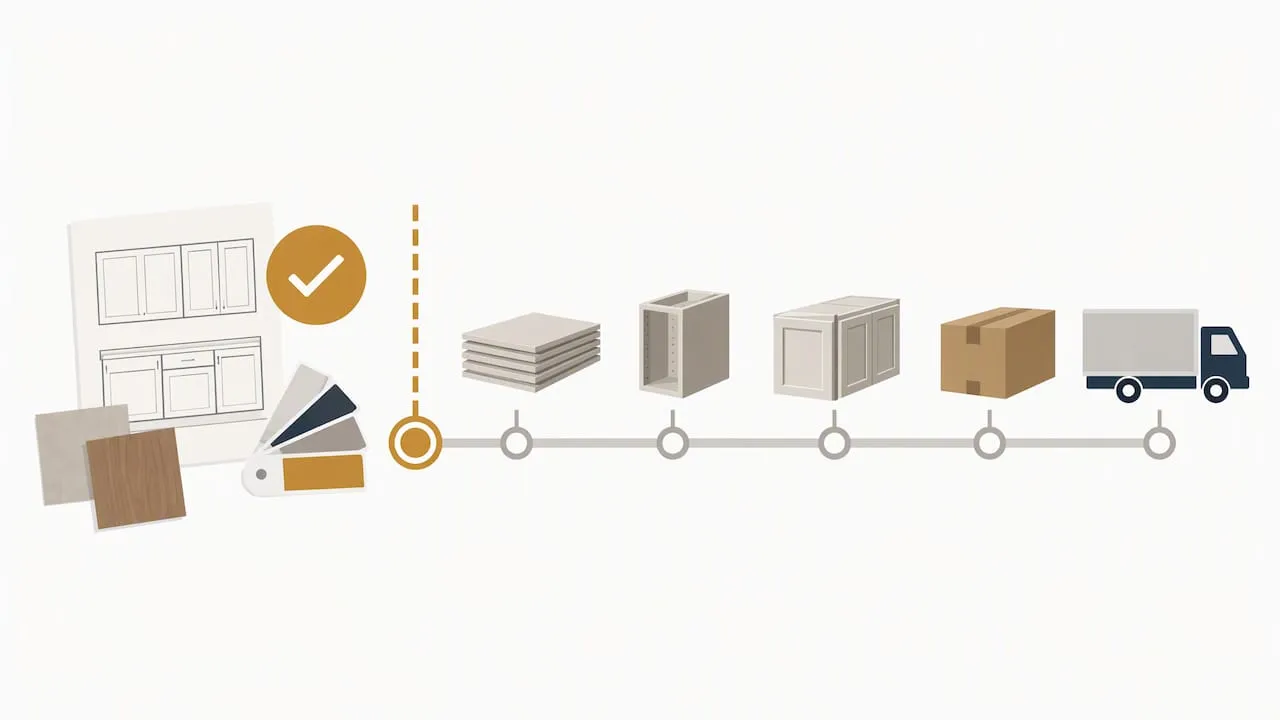
The date on your calendar and the date on your supplier’s calendar are rarely the same. Production slots are reserved once plans are final and money has changed hands, so everything before that is unscheduled time.
Track these milestones in order:
- Final measurements and detailed drawings are confirmed.
- Plans are signed and the deposit is paid, which starts the supplier clock.
- Materials are ordered and production begins.
- Finishing and curing are completed, which takes longer for painted or specialty finishes.
- Cabinets ship and travel to your home or a staging location.
- Installation begins on site.
Changes after sign-off usually restart or extend part of this sequence and can carry change fees. A late door-style change can extend the schedule. Ask your supplier in writing which changes are still allowed after the deposit.
What makes cabinet lead time longer or shorter?
Most delays trace back to a handful of causes, and many are within your control.
- Door style and finish: painted finishes often add curing time, and specialty finishes take longer still.
- Sizing and materials: unusual dimensions, on-site adjustments and limited material availability slow production.
- Hardware and appliances: pulls, hinges and appliance specs need to be settled early because cabinets are built around them.
- Shop backlog and local labor: a busy manufacturer or a short-staffed install crew pushes dates out.
- Seasonality and supply chain: peak remodeling months, shipping delays and tariffs all add uncertainty.
- Late decisions and measurement errors: a measurement error or delayed decision can extend the schedule.
Pro Tip: Choose your finish, hardware and appliances before you sign the cabinet order, not after. Those three choices cause most of the avoidable delays we see.
How do you build a kitchen schedule around cabinet lead time?
Work backward from the date you want your kitchen finished. Thorough planning can take three to six months between final design and a finished kitchen, and that guidance recommends building flexibility into timelines and budgets.
- Set your target finish date. Pick the date you want to cook in the new kitchen.
- Subtract installation and finish work. Allow time for countertops, backsplash, plumbing, electrical and punch-list items after the cabinets go in.
- Subtract the cabinet lead time for your chosen type, then add a buffer. Our rule of thumb is a few extra days for stock or RTA and a few extra weeks for custom.
- Set your sign-off and deposit date. This is the deadline that really controls everything else.
- Order long-lead items early, including appliances, hardware and specialty finishes.
- Sequence the critical path: demolition, rough-ins, cabinet installation, countertops, then finish work. Demo should not start until your cabinet ship date is confirmed.
- Plan your temporary kitchen. Our temporary kitchen plan covers the checklist and sequencing.
How can you shorten or manage lead time?
You cannot control a supplier’s backlog, but you can control how much of the schedule depends on it.
- Choose in-stock or RTA when timing is your main concern, accepting the extra assembly labor.
- Accept standard finishes or off-the-shelf doors to stay out of custom finishing queues.
- Lock your design decisions early and ask about expedited production or shipping if the deadline is firm.
- Order appliances and hardware at the same time as cabinets so one late item does not stall installation.
- Get delivery windows and confirmed ship dates in writing. A verbal estimate is not a commitment.
- Check in at set points, such as when production starts and when the order ships, instead of waiting for a surprise.
If you are weighing speed against spending, our kitchen budget breakdown shows how cabinet choices fit into a realistic budget.
What should you do on delivery and installation day?
Cabinets rarely arrive as a few tidy crates. Expect many boxes, and treat the unboxing as part of the schedule.
- Inventory every box against the packing list and your order.
- Photograph any damage immediately and report it within the manufacturer’s damage window. For RTA orders, open and inspect boxes within the first five days.
- Store cabinets indoors if installation is delayed, away from moisture and temperature extremes.
- Clarify who does what: which tasks your contractor handles and which prep, such as clearing the space, falls to you.
Early deliveries are not always a gift. If the install crew is not ready, you now own a garage full of boxes, so confirm storage space before the truck is scheduled.
Why are cabinet lead times so unpredictable lately?
Industry reporting points to pressure from several directions at once. NKBA reported in Q1 2025 that economic uncertainty, tariff concerns and labor shortages raised input costs and stretched lead times for key product lines, including cabinetry.
Designers reported shops quoting lead times of three to four months, along with cabinet scarcity and several price increases. Some designers even tried unfamiliar cabinet brands just to get better availability.
Cabinets also often account for a large share of a remodel’s budget, and industry experts expect continued cost and lead-time pressure from shipping costs, tariffs and labor shortages. The practical takeaway is simple: order early, build contingency days into your calendar, and consider RTA or stock options if speed matters more than customization.
Why do we lock cabinet orders to signed plans?
Here is our editorial stance: most timeline surprises are decision problems, not manufacturing problems. When a cabinet order is tied to signed plans and a deposit, the lead time is locked and everyone works from the same date. We confirm ship dates in writing, add contingency days to the schedule, and push for quick calls on finish, hardware and appliances. The homeowners with the smoothest projects are rarely the ones with the fastest supplier. They are the ones who decided early.
— Vlad
How do we keep your cabinet schedule on track?

We plan your kitchen remodel around the cabinet clock from day one, coordinating vendors, ordering and installation so you are not left guessing. Our reliable scheduling and honest pricing support an organized remodeling process.
- Kitchen remodeling with planning and vendor coordination
- Cabinet installation and finish work in one organized process
- Clear communication on dates, decisions and next steps
Ready to put real dates on your kitchen? Request a free estimate or schedule a consultation with our team today.
FAQ
How long does it take to get cabinets in?
It depends on the type. Stock cabinets often arrive in 1–5 weeks, semi-custom takes longer, and custom can run several months. The clock generally starts after final plans are signed and the deposit is paid.
What are the lead times for DIY kitchens?
DIY kitchens usually mean RTA cabinets, which can arrive within about two weeks when profiles are in stock. Add assembly time at roughly 20–30 minutes per cabinet, plus a few days of buffer for shipping surprises.
What is a realistic budget for a new kitchen?
Cabinets often make up 25%–40% of a remodel budget, so your cabinet choice shapes the total. Our kitchen budget breakdown walks through realistic spending ranges, and we can provide a project-specific quote on request.
What should you check before choosing a cabinet color?
Check finish type first, because painted and specialty finishes can add curing time and lengthen your wait. Standard finishes usually ship faster, so confirm color options against your schedule before you sign.
Sources
- Economic Uncertainty, Including Questions About the Impact of Tariffs, is Tempering Predicted K&B Industry Growth – NKBA
- What’s going on with Cabinets? - NKBA
- All About Ready-to-Assemble Cabinets - This Old House
- All About Kitchen Cabinets - This Old House
- Experts Predict the Average Cost of Kitchen Cabinets in 2025
